Area · Crayford · DA1
Removals in
Crayford.
Removals across Crayford — the terraces around the old town and Crayford Road, the post-war estates at Barnes Cray, and the newer riverside developments down towards the Cray and the Dartford boundary. The eastern end of the borough, and the easiest part of it to get a lorry into.

Local access · DA1
The one corner of the borough with room to work.
Crayford is, straightforwardly, the easiest area in the catchment to run a removal in. The post-war estates at Barnes Cray and the newer developments towards the river were built with parking in mind, driveways are common, and the roads are wide enough that a full-size lorry can stand without blocking anyone. That is unusual in this borough and it shows up in how a Crayford move runs: fewer shuttle runs, shorter carries, and a day that finishes closer to when it was supposed to.
The exception is the old town. The streets around Crayford Road and the High Street are older and tighter, with terraces fronting directly onto narrow pavements and a one-way system that decides which direction a vehicle can approach from. Those addresses are planned like the rest of the borough — approach checked, parking arranged, vehicle chosen against the street rather than the postcode.
The other local consideration is the river. Parts of Crayford sit low in the Cray valley, and ground-floor storage, garages and outbuildings down there are more likely to have damp. It is worth a mention at survey if anything has been stored in one, because cardboard that has sat in a damp garage does not survive being lifted.
Property stock · Estates, terraces and new build
Three eras, three different loading days.
The Barnes Cray estates are post-war family housing: regular layouts, reasonable door widths, usually a driveway or a hardstanding. These are the most predictable jobs we do and they are quoted with the fewest unknowns.
The old-town terraces are the opposite end. Narrow hallways, stairs with a turn, and front doors opening more or less onto the pavement. The same cautions apply as anywhere in the borough with Victorian stock: measure the turn rather than the doorway, protect the frames, and plan the heavy items for while the floor is clear.
The newer riverside developments bring the third pattern — apartment blocks with goods lifts, booked loading bays and building management who need notice. Those are easy jobs when the lift is booked and genuinely difficult when it is not, so we confirm the arrangement with the management company before the date rather than arriving to find the lift in use.
Services · What runs from here
Local work, clearance and the European routes.
Full house removals, man and van, office moves for the units around the industrial estates, storage, and house clearance including probate and end-of-tenancy work. Crayford generates more clearance work than most of the borough, partly because of the amount of long-held family housing on the estates, and those jobs are sorted before they are cleared rather than skipped wholesale.
Crayford sits inside the European pickup catchment too. A DA1 address moving to France, Spain, Italy or Portugal is collected here by the crew that drives it, with the customs filing handled by the same team. Being at the eastern edge of the borough makes no difference to that: the drive to the Channel starts a few minutes earlier, and nothing else changes.
Catchment · Where Crayford sits
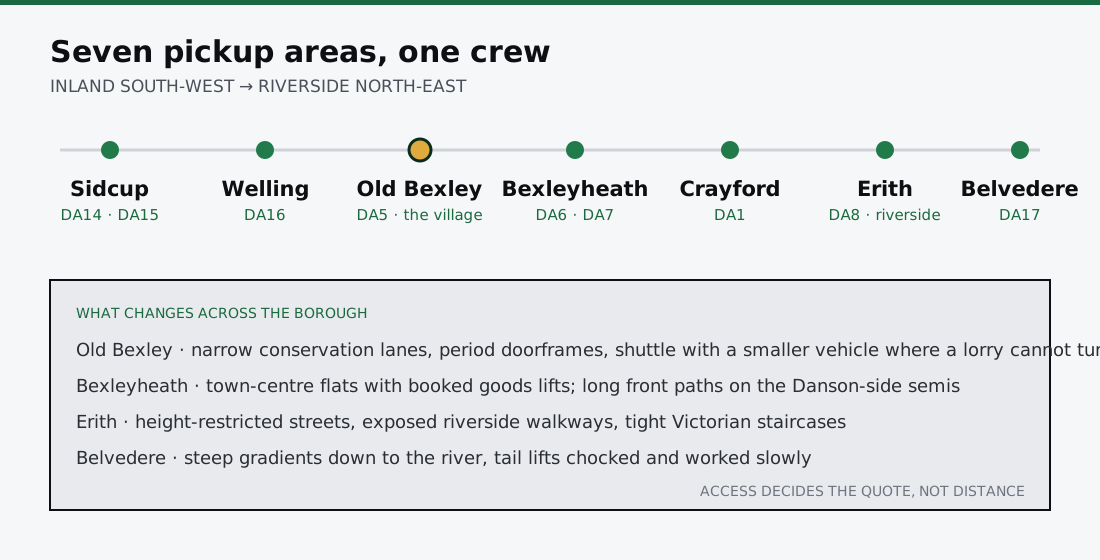
One crew across
the whole borough.
Questions · Removals Crayford
Common questions.
Is Crayford easier to move in than the rest of the borough?
Generally yes, and it is worth saying plainly because it affects the quote. The post-war estates at Barnes Cray and the newer riverside developments were built with parking in mind, driveways are common, and the roads take a full-size lorry without blocking anyone. That means shorter carries, fewer shuttle runs and less crew time than an equivalent house in Welling or Erith. The exception is the old town around Crayford Road and the High Street, where the terraces front onto narrow pavements and a one-way system decides the approach — those are planned like anywhere else.
Do you move into the riverside apartment blocks in Crayford?
Yes, and the goods lift is the whole plan. Those buildings generally have a loading bay and a lift that have to be booked with the building management, often with a time window attached and sometimes shared with other deliveries. We confirm the lift dimensions, the bay arrangement and any restriction with the management company before the date. Where a lift cannot be booked or will not take the larger items, a stair carry goes into the quote in advance rather than being discovered on the morning, so the crew size and the time allowance are right.
Things have been stored in a damp garage — is that a problem?
It is worth flagging, and it comes up more in the Cray valley than elsewhere in the borough because parts of Crayford sit low. Cardboard that has spent a winter in a damp garage or outbuilding frequently will not survive being lifted, and a box that fails mid-carry is how things get broken. If anything is coming out of a garage, shed or outbuilding, mention it at survey and photograph it. We bring replacement boxes and repack where needed rather than trusting the originals, which costs a little time and saves considerably more.
Can you handle a full house clearance in Crayford?
Yes, full or part, including probate and end-of-tenancy work. The approach is to sort before clearing: what the family is keeping, what should be valued before any decision is made, and what is genuinely going. Nothing in the first two categories moves until you say so. Usable furniture and household goods go to reuse and charity routes where they will be accepted, and metals, electricals and textiles are separated for recycling. We do not hold a waste carrier licence, so anything genuinely going to disposal is passed to a licensed firm and we will tell you so.
Related · Bexley removals
Begin · Photos and inventory
Get a written quote
for your Bexley move.
Send a few photos and a rough inventory through the form and we come back with an itemised, written quote for your specific home, access and dates — nothing added on the day.